Case Study > Mirosław Wiśniewski Architecture Ltd.- Science and Technology Museum in Poland
KOZ architectes and
ARCHICAD
Winner of ArchDaily Building of the year 2014
Christophe Ouhayoun and Nicolas Ziesel founded Koz Architects in
1999 with the goal of developing expressive and cheerful architecture,
founded on discussion, experimentation and “creative democracy,”
open to any situation that drives social and environmental innovations
ever further.
Fifteen years later, after 75 competitions and tenders, 27
of which were wins and 18 that were built, Koz Architects relies on a
13-member team and solid partners like PLAN01, which is a group of
five architectural firms and an environmental study office. “We do not
ask people who work with us to design our fads or obsessions, but to
contribute real value through their know-how,” Christophe Ouhayoun
points out. “A need, a demand for collaborative work is what led us to
choose ARCHICAD back in 2009.” It was a rapid switch: they had barely
six months to equip and train a team to use a tool they can rely on. KOZ
Architects works today with Teamwork with eight ARCHICAD licenses.
KOZ architectes - Tête en l’Air
“The idea of designing
a project in plan, then
modeling it for communicating
the project
seemed completely
absurd...especially with
the additional requirement
of making a specific
model for thermal
simulation.”Nicolas Ziesel, architect
Previously working with 2D design software that was fast and effectively
used by the team, Christophe Ouhayoun and Nicolas Ziesel still came to
a different conclusion. “We produce a lot of images ourselves, and the idea of designing a project in plan, then modeling it for communicating
the project seemed completely absurd...especially with the additional
requirement of making a specific model for thermal simulation,” says
Nicolas Ziesel. This need to evolve towards using 3D for conceptual
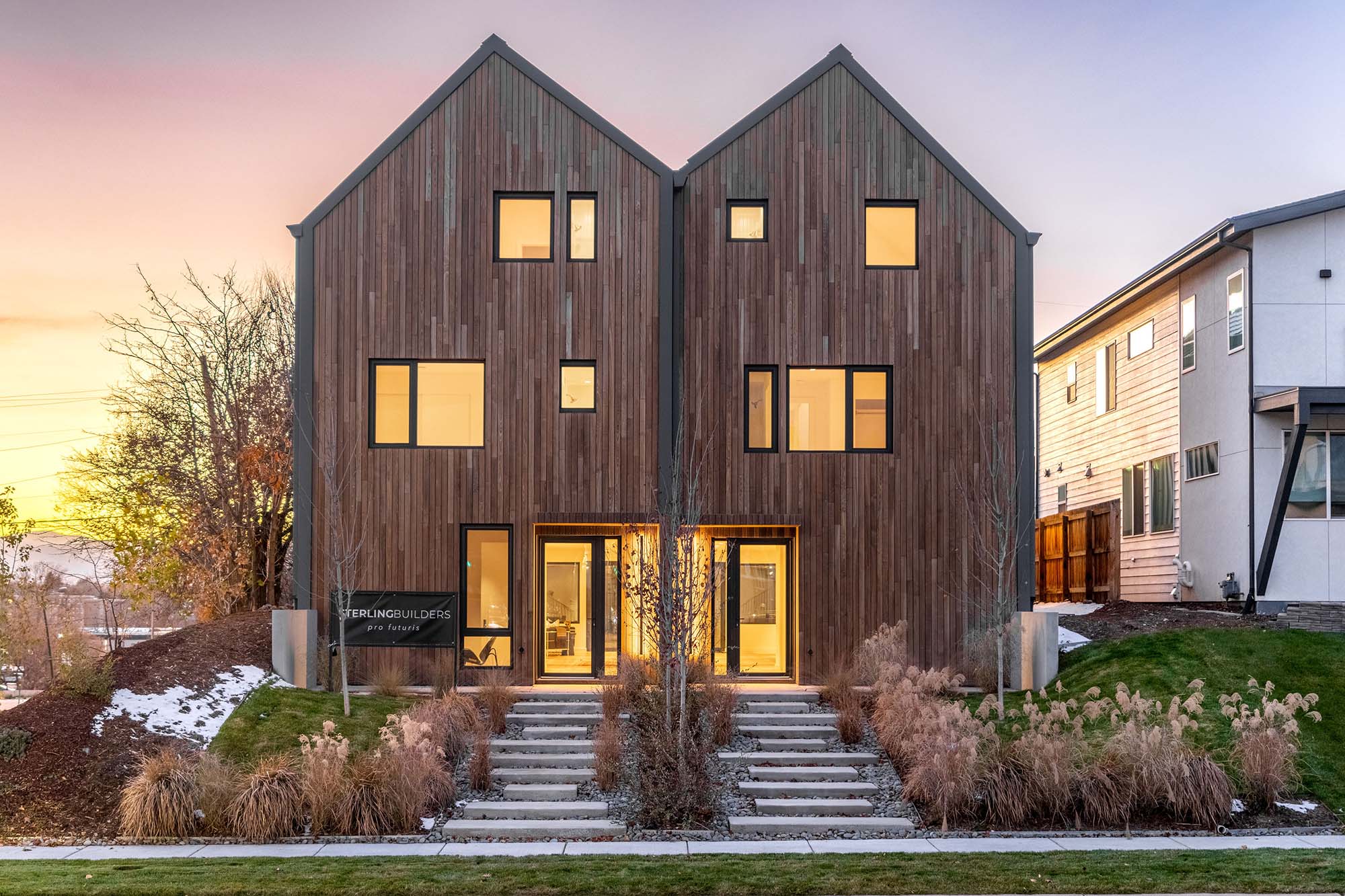
design was confirmed with the “Tête en l’Air” project, which is a tough
combination of rehabilitating a social housing unit and creating another
15 new, wooden buildings. Koz shaped a new concept of high-density
living by creating multiple, small, “intermediate spaces” around the plot
out of wood.
Tête en l’Air, photo © cecile septet
The project was awarded the 2nd National Prize of Wood Construction in 2013 as well as the ArchDaily Prize for “Building of the Year
2014” in the Housing category. In addition to being a “flagship” project that
brings Koz architects recognition, the collaboration with carpenters on this
project was the deciding factor in their move towards ARCHICAD. “It’s the
same work, but carpenters think in 3D from the concept to execution. Their
3D attitude really prevails until the very end; this is a real value. It’s not only
about the object as training but an object that actually has to be built. On
‘Tête en l’Air’ we were still in 2D: we had nothing to show them and nothing
we could do with the models they gave us,” regrets Christophe Ouhayoun.
Tête en l’Air, photo © cecile septet
ARCHICAD has thus emerged as a particularly tailored tool. “In contrast to concrete structures, wood structures integrate an enormous amount
of elements that have real sensibility through space and if the project
is not modeled intelligently in 3D, we cannot understand it,” said
Christophe Ouhayoun. “What is interesting with this experience with
wood is that the project is accepted with the help of a digital model, and
not just a flat drawing,” he added. In addition to designing in 3D like
carpenters, ARCHICAD also helps communication with them. “Carpenters
use design software that are very specific and sometimes even rare...
but data exchange is achieved perfectly thanks to IFC,” confirms Nicolas
Ziesel. “Finding a common language for different file types is the future!
If there is no agreement on the common format, everyone will lose for
sure,” predicts Christophe Ouhayoun. Interoperability: a title shared
mutually by Koz and all ARCHICAD architects.
KOZ architectes - B4B
Since 2009, Koz architects has used ARCHICAD in all phases of their projects, never looking back to designing in 2D. The B4B building in the
IDZ (Integrated Development Zone) of Trapeze at Boulogne was their
first project using ARCHICAD: a small slice of a larger plot, which still had
to incorporate three different programs (a specialized kindergarten,
a medical center and social housing) whose entity and functionality
are identified by three large terraces, gaps and different material
types (white and smooth plaster, rough wood). A rough idea was
experimented with and developed entirely in ARCHICAD with the support
and guidance of Brenac et Gonzales, the coordinating agency of the
macro-plot, who were also equipped with ARCHICAD - an “in the field”
exchange of experience that confirmed ARCHICAD was the right choice,
pushing Koz even further in its use.
“Collaborative design: it
seems obvious today...
but it’s still something
like a phenomenon --
everyone working on
the same document
without any worry.”Christophe Ouhayoun , architect
KOZ architectes - La Halle aux Farines in construction
KOZ architectes - La Halle aux Farines in section
“In ARCHICAD, a line is not just a line, but an element in space. Each drawn element contains information, value, thickness...and this, this
changes everything,” says Nicolas Ziesel enthusiastically. “It changes
everything because we don’t draw just anything anymore...There are
architects who require the project to start out as a sketch. We never
make sketches before starting a project. Concepts, patterns, forms,
ideas, etc. are all verified on the 3D model. The digital model thus
provides ‘the ideal way to explore possibilities.’ We can develop a
concept that immediately has physical characteristics that immediately
takes form: we study its scheme, dimensions and its footprint...it all
happens very fast.” “And some experimentation that we do not keep for
one project can serve us for another,” explains Christophe Ouhayoun. In this context of experimentation and creative democracy, ARCHICAD’s
Teamwork is an undeniable advantage. “Collaborative design: it seems
obvious today...but it’s still something like a phenomenon -- everyone
La Halle aux Farines in construction
La Halle aux Farines in Elevation
working on the same document without any worry.” Christophe
Ouhayoun is still amazed. “People working on the project are not only
performers; they participate in the development of the project. Speaking
as associates, we are obliged to draw less and less. However, we
appreciate that ARCHICAD is able to produce a level of documentation
that communicates well, like quantity take-offs, which ARCHICAD helps
with considerably. We don’t know how we got by before...and we do not
understand how others get by...It is a tool that we could not do without,
especially for housing,” says Christopher Ouhayoun.
Nicolas Ziesel emphasizes the advantage of plans, sections and
elevations being in sync. “To have constantly updated plans, sections
and elevations without the help of a digital model is a nightmare...
Windows that were placed correctly on the floor plan were not
necessarily correct in elevation view, and for big housing projects like
the ones we deal with, this is a crucial matter.” Similarly, Koz always
prepares up-to-date visualizations for communicating the project.
Christophe Ouhayoun explains their adopted workflow: “The graphic
designer receives the first model and applies the pre-defined materials.
In five minutes, he has a prepared model and can start placing cameras
to choose interesting points of view. Meanwhile, the evolving project
model can be swapped to always have an updated visualization of the
project, giving the impression of a final product, even though it might
develop even further.“
KOZ architectes - La Halle aux Farines
Evolution towards an increasingly collaborative workflow both within
the office, and with PLAN01, but also with external partners to
produce prestigious, sometimes extravagant projects with an intricate
blend of functional, technological, financial qualities that comply
with environmental indications... This is what ARCHICAD facilitates for
Koz Architects, who will be delivering a new university restaurant in
November for the CROUS of Paris and the University of Paris Diderot: a
structure made entirely of glass and pre-fabricated timber completely
modeled in ARCHICAD, right down to the smallest detail.
KOZ architectes
Interviewed by Abvent, GRAPHISOFT Partner since 1985 and exclusive ARCHICAD distributor for France, Switzerland and French-speaking Africa.
KOZ architectes
About GRAPHISOFT
GRAPHISOFT® ignited the BIM revolution in 1984 with ARCHICAD®, the industry first BIM software for architects. GRAPHISOFT continues to lead the industry with innovative solutions such as its revolutionary BIMcloud®, the world’s first real-time BIM collaboration environment; and BIMx®, the world’s leading mobile app for lightweight access to BIM for non-professionals. GRAPHISOFT is part of the Nemetschek Group.